
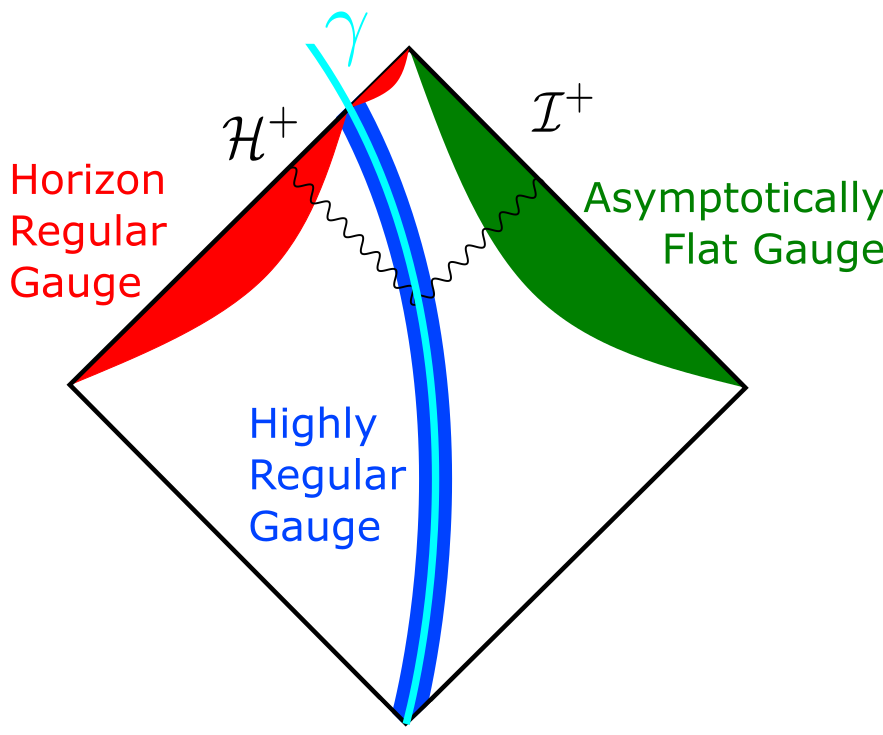
Fig 1: Penrose diagram depicting a compact object travelling along into a black hole horizon. The black wave lines depict gravitational waves which travel out to future null infinity or fall into the future horizon . To perform second-order calculations, we employ well-behaved gauges near , , and . Furthermore, these boundaries possess associated asymptotic symmetries and reference frames that directly affect second-order calculations. Correctly modelling the evolution of these frames captures the memory effect in self-force waveforms, a detectable phenomenon resulting in the permanent displacement of observers after a gravitational wave passes. [Image credit: Andrew Spiers]
Accurate waveform modelling for LISA requires a rigorous understanding of the spacetime structure at both its asymptotic boundaries and the central black hole horizon. Gravitational wave memory—a persistent, hereditary displacement of observer position—emerges due to gravitational waves emitted during a binary inspiral and merger. Capturing this secular evolution is essential for overall phase accuracy due to memory distortion, where the memory backreacts on spacetime, affecting the evolution of the binary. Additionally, asymptotic frames present a distinct theoretical challenge: waveforms extracted at future null infinity, as well as physical fluxes crossing the future event horizon, are subject to Bondi-Metzner-Sachs (BMS) and near-horizon frame ambiguities. To compare high-accuracy self-force waveforms with other binary modelling techniques, such as Numerical Relativity and post-Newtonian theory, precise knowledge of BMS reference frames is crucial.
We develop theoretical frameworks to fix the reference frames at both and for extreme mass-ratio inspirals (EMRIs). This ensures that our second-order waveforms are physically unambiguous and free from gauge-induced artefacts at either boundary. Work is now underway to extend and implement these frame-fixing procedures and memory calculations to generic orbits—including high eccentricity and inclination—and to the Kerr background, both at and .
Current focus:
- Systematic frame-fixing protocols at null infinity and the event horizon for generic orbits in Schwarzschild and Kerr.
- Computation of second-order secular memory effects for astrophysically realistic inspirals.
- Aligning self-force reference frames with Numerical Relativity for high-precision waveform cross-validation.
- Assessing the impact of the memory contribution on LISA parameter estimation.