Precision waveform modelling for asymmetric compact binaries across the gravitational-wave spectrum
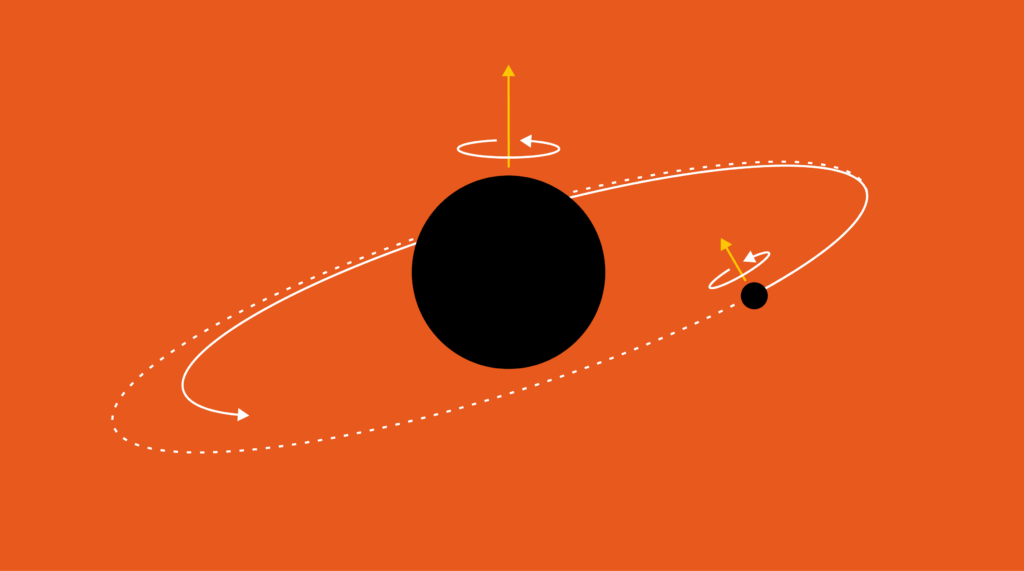
The Multiscale Self-Force Collaboration brings together researchers from around the world to develop fast, accurate waveform models for asymmetric compact binary systems, with a particular focus on extreme- and intermediate-mass-ratio inspirals (EMRIs and IMRIs). Our waveform models are directly relevant to LISA’s EMRI science, and increasingly to observations by ground-based detectors — LIGO, Virgo, KAGRA, and the next-generation Einstein Telescope and Cosmic Explorer — where intermediate-mass-ratio systems fall within the detection band. Our approach is grounded in gravitational self-force (GSF) theory, which treats the smaller compact object as a perturbation of the spacetime of the larger black hole.
With leadership from researchers at the University of Southampton, University College Dublin, and the Niels Bohr Institute, we are founding contributors to the Black Hole Perturbation Toolkit and key members of the LISA Consortium and LISA Distributed Data Processing Centre.
Why extreme mass-ratio inspirals?
Extreme-mass-ratio inspirals offer a unique window into some of the deepest questions in physics: how do supermassive black holes form and grow? Does Einstein’s general relativity hold in the extreme curvature of a black hole’s immediate vicinity? What is the population of compact objects — neutron stars, stellar-mass black holes — in the centres of galaxies? The answers are encoded in the gravitational waves these systems emit — waves that will be detected by LISA, the European Space Agency’s space-based gravitational-wave observatory due to launch in the 2030s.
Realising that scientific potential requires a fundamental advance in waveform modelling. When a stellar-mass compact object spirals into a supermassive black hole, it executes hundreds of thousands of orbits before the final plunge — each one a precise probe of the black hole’s spacetime geometry. Extracting that information requires tracking the waveform phase to extraordinary precision, far beyond what the methods developed for ground-based detectors can provide.
The gravitational self-force — the back-reaction of the smaller body on its own motion through curved spacetime — is the natural framework for this regime, and the foundation on which LISA-ready EMRI waveform models must be built.
Beyond EMRIs
The techniques we develop are not limited to extreme-mass-ratio systems. The same gravitational self-force framework, and the multiscale expansion that makes it computationally tractable, extends naturally to intermediate mass-ratio inspirals (IMRIs) — binaries in which a compact object spirals into an intermediate-mass black hole, with mass ratios in the range roughly 1:100 to 1:10,000.
IMRIs occupy the mass-ratio gap between EMRIs and the comparable-mass binaries targeted by conventional waveform models. At the higher frequencies accessible to ground-based observatories — LIGO, Virgo, KAGRA, and the next-generation Einstein Telescope and Cosmic Explorer — IMRIs are a priority science target. Accurate waveform models will be essential for their detection and characterisation, and we are actively extending our methods to meet that need.
A multiscale problem
Asymmetric binaries are intrinsically multiscale: the orbital, resonance and radiation-reaction timescales are separated by powers of the small mass ratio. The multiscale expansion we develop systematically resolves this hierarchy and underpins the next generation of adiabatic and post-adiabatic waveform templates.
By exploiting this structure — combining a multiscale expansion of the Einstein field equations with modern GPU-accelerated computation — we can generate long inspiralling waveforms in milliseconds.
Key research themes
Our work spans three interconnected themes:
- Second-order self-force theory
We have developed the first complete second-order GSF computational framework, providing accuracy critical for parameter estimation with LISA and next-generation ground-based detectors. - Multiscale waveform generation
Our two-stage offline–online approach separates slow field-equation solutions from rapid waveform synthesis, enabling real-time Bayesian inference for gravitational-wave data analysis. - Open science & community tools
We develop and maintain open-source software through the Black Hole Perturbation Toolkit, making gravitational-wave science more accessible to the broader research community.
Membership
The collaboration brings together researchers at all career stages — PhD students, postdocs, and faculty — working across gravitational theory, numerical methods, and data analysis. Members contribute to shared code infrastructure, joint publications, and the collaborative development of waveform models that will underpin gravitational-wave science with LISA and next-generation ground-based detectors.
We welcome new members with backgrounds in general relativity, mathematical physics, numerical relativity, or gravitational-wave data analysis. If you are interested in joining, please visit the Members page or get in touch.
Funding
The Multiscale Self-Force Collaboration is supported by the European Research Council, UKRI, Research Ireland, the Royal Society, and ESA PRODEX.